
Battling Barbara Buttrick — The Mighty Atom of Women’s Boxing
In the long and uneven history of women’s boxing, a handful of fighters stand out for their ability in the ring and also for their determination to compete when the sport offered few opportunities. One of the most important among them was Battling Barbara Buttrick.
Fighting during the 1940s and 1950s, decades when women’s boxing was often marginalized or outright prohibited, Buttrick built a career that stretched across continents and helped sustain interest in the sport during one of its quietest periods.
Early Life and Introduction to Boxing
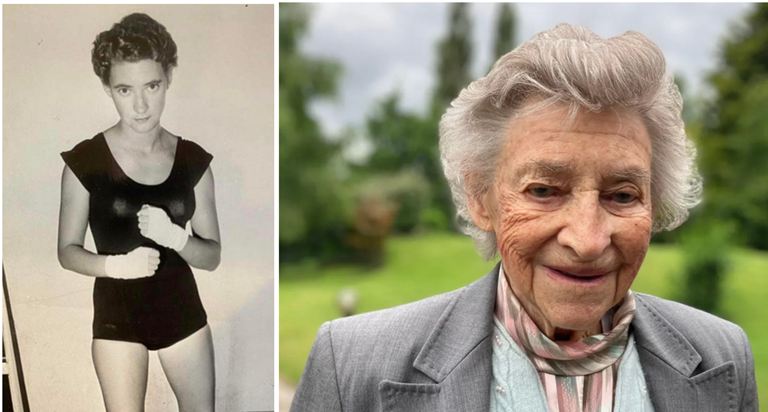
Barbara Buttrick was born on December 3, 1929, in Cottingham, England. Although she was small in stature, standing just under five feet tall and often fighting at around 98 pounds, she possessed an admirable amount of determination.
As a young woman, she became interested in boxing at a time when the sport offered almost no structured opportunities for female competitors. Unlike their male counterparts, women rarely had access to sanctioned amateur programs or professional circuits.
Even so, Buttrick persisted. She began competing in exhibition bouts in Britain during the late 1940s, gradually developing both her skills and her reputation. She was quick and resilient, and she was willing to face any opponent, thus earning her the nickname “The Mighty Atom.”
Taking Women’s Boxing Across the Atlantic
By the early 1950s, opportunities for women boxers in Britain were extremely limited. Buttrick eventually moved to the United States, where small promoters were occasionally willing to stage women’s bouts.
In the U.S. and Canada, Buttrick found a network of promoters, venues, and opponents that allowed her to build a professional career. Fighting in places such as Ohio and other Midwestern venues, Buttrick began competing more frequently. Even though the crowds were often curious rather than supportive or accepting, her ability inside the ring quickly won their respect.
Buttrick allegedly fought 1000’s of exhibitions, many of those against men. She helped maintain public awareness of women’s boxing when the sport lacked a formal structure.
One of her matches in Canada was the first women’s bout that was broadcast on the radio. In 1954, she was involved in the first women’s bout that was nationally televised in America.
A Champion in a Difficult Era
During the early 1950s Buttrick fought a series of bouts with American boxer Jo-Ann Hagen, contests that were widely promoted as world championship fights. In 1957, Buttrick defeated Hagen in Toledo, Ohio, to claim recognition as the women’s world flyweight champion. The victory confirmed her standing as one of the leading female fighters of her era.
That being said, it is important to remember the context of the time. Women’s boxing lacked unified sanctioning bodies, formal rankings, and consistent regulatory oversight. Fighters like Buttrick often had to create opportunities for themselves, accepting fights wherever promoters were willing to stage them.
Despite these challenges, she compiled an impressive professional record and became one of the most recognizable female boxers of the 1950s.
Although women’s boxing had inconsistent record-keeping in the 1950s, most historical records credit Buttrick with more than 30 professional wins and only a single loss.
Fighting When the Sport Had Few Doors Open
The significance of Barbara Buttrick’s career lies both in the victories she achieved and in the era in which she competed. For long stretches of the twentieth century, women’s boxing existed on the margins of the sport. In some jurisdictions it was discouraged; in others it was banned entirely.
As a result, female fighters often relied on exhibition bouts, traveling promotions, and independent promoters simply to stay active. Buttrick navigated that difficult landscape with persistence. She fought in England, Canada, and the United States, toured internationally, and helped demonstrate that women’s boxing could draw legitimate public interest.
Beyond the Ring
After her fighting career concluded, Buttrick remained connected to the sport. She became involved in promoting and advocating for women’s boxing, helping to create additional opportunities for female fighters in later decades. Her efforts were part of the long process that eventually led to the revival of women’s boxing in the 1990s and its continued growth in the twenty-first century.
Modern champions such as Christy Martin and Laila Ali fought in an environment far more visible than the one Buttrick knew, but the groundwork laid by earlier pioneers played an important role in that progress.
Remembering the “Mighty Atom”
Looking back, Barbara Buttrick’s career represents an important chapter in the history of women’s boxing. At a time when opportunities for female fighters were scarce and the sport lacked consistent recognition, she traveled widely and fought frequently, establishing herself as one of the leading women boxers of her era.
For women’s boxing, she was more than a champion. The “Mighty Atom” was one of the athletes who helped ensure the sport would endure.
In the mid-1990s, Buttrick founded the Women’s International Boxing Federation (WIBF), where she served as president.
She was inducted into the International Women’s Boxing Hall of Fame in 2014.
In 2019, Buttrick became one of the first female fighters (and the first English woman boxer) to be nominated into the International Boxing Hall of Fame (IBHOF).